
What is a Recession?
Economic cycles are a natural part of every economy, fluctuating between periods of growth and contraction. Among these phases, recessions stand out as one of the most challenging,
Economic cycles are a natural part of every economy, fluctuating between periods of growth and contraction. Among these phases, recessions stand out as one of the most challenging, characterized by a sustained decline in economic activity that can last for months or even years. Understanding recessions is crucial, not only for economists and policymakers but for businesses, investors, and individuals as well. By grasping the fundamental aspects of a recession, you can better prepare for the potential impacts and navigate the economic turbulence that often accompanies these downturns.
A recession, in its simplest terms, is defined as a significant decline in economic activity across the economy that lasts for an extended period, typically recognized by a decrease in Gross Domestic Product (GDP) for two consecutive quarters. However, this definition only scratches the surface of what a recession entails. The ripple effects of a recession extend far beyond the numbers, influencing everything from employment rates and consumer behavior to global trade and financial markets.
What Causes a Recession?
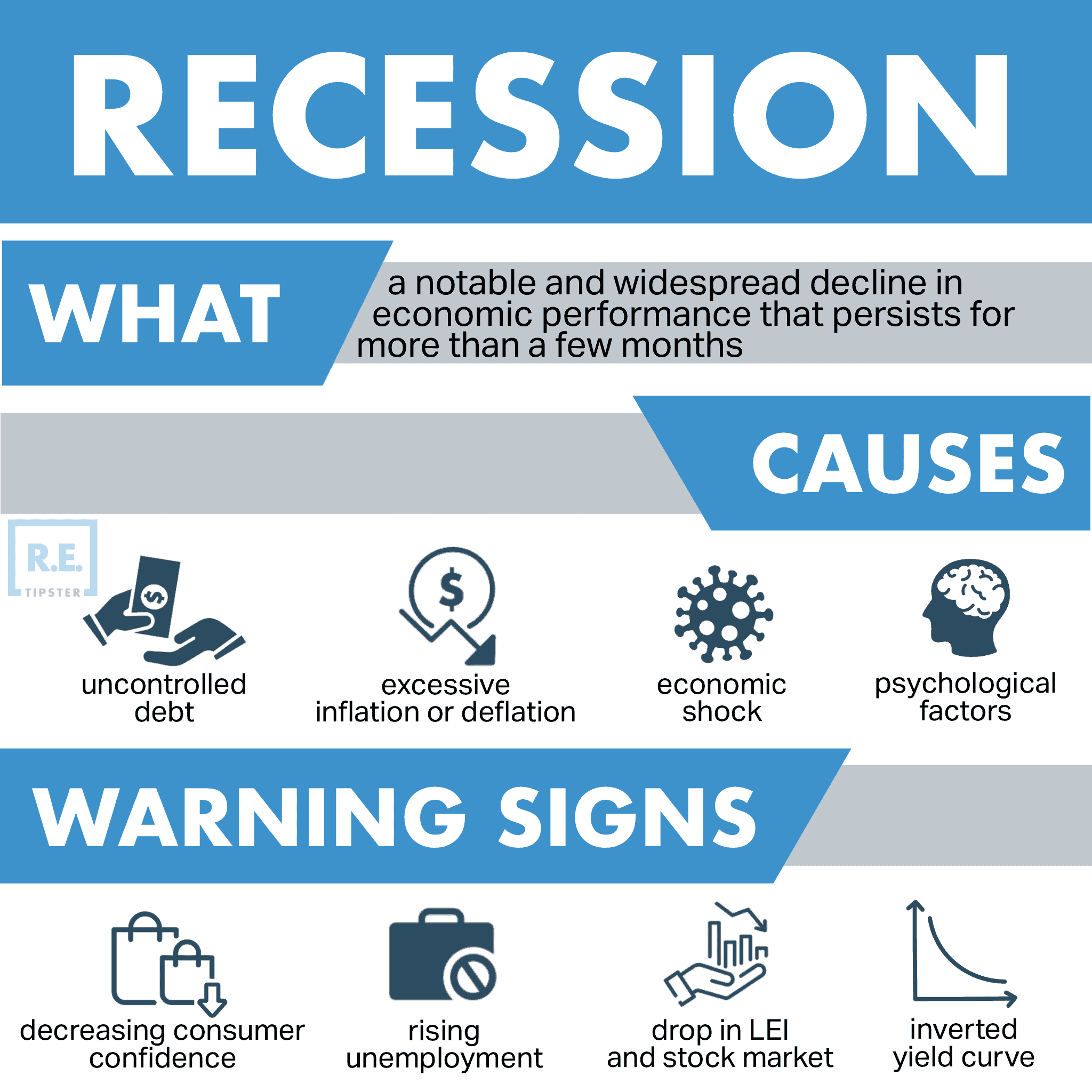
Recessions occur when the economy experiences a significant decline in activity, marked by falling GDP, rising unemployment, and reduced consumer spending. These downturns are often triggered by a combination of internal and external factors that disrupt economic stability. Key causes and triggers of recessions include financial crises, high inflation, external shocks, excessive debt, and shifts in government policy.
Key Causes and Triggers:
- Financial Crises:
- Examples: The 2008 financial crisis, sparked by the collapse of the housing market and widespread defaults on mortgage-backed securities.
- Impact: Reduced access to credit, lower consumer and business spending, and a sharp economic downturn.
- High Inflation:
- Examples: The stagflation of the 1970s, where high inflation coincided with stagnant economic growth.
- Impact: Erosion of purchasing power, increased interest rates, and reduced demand, leading to a contraction in economic activity.
- External Shocks:
- Examples: The COVID-19 pandemic, natural disasters, geopolitical conflicts.
- Impact: Sudden disruptions to supply chains, business closures, job losses, and a collapse in consumer confidence.
- Excessive Debt:
- Examples: The debt-driven expansion prior to the 2008 financial crisis.
- Impact: Vulnerability to economic changes, rising defaults, and financial crises that lead to broader economic contractions.
- Government Policy Changes:
- Examples: Austerity measures or rapid tightening of monetary policy.
- Impact: Reduced public spending, higher taxes, and stifled economic growth, which can exacerbate a downturn.
Recession's Impact on Society
Recessions aren't just numbers on a financial report; they're events that ripple through every layer of society, affecting how people live, work, and interact with one another. While the headlines might focus on GDP and stock market declines, the real story lies in the day-to-day experiences of individuals and communities as they navigate economic downturns. From the stress of losing a job to the strain on social services, recessions leave a lasting mark on the social fabric.
Here's how recessions impact different aspects of society:
Employment and Income Inequality:
- Job losses and hiring freezes lead to higher unemployment rates.
- Reduced household income increases financial stress and economic inequality.
- Those with fewer skills or lower education levels are disproportionately affected, widening the wealth gap.
Social Services and Government Programs:
- Higher demand for unemployment benefits, food assistance, and healthcare services during recessions.
- Government budgets are strained due to reduced tax revenues, leading to potential cuts in essential services.
- Vulnerable populations may be left without adequate support, exacerbating social challenges.
Community and Social Cohesion:
- Economic pressures can decrease volunteerism, charitable giving, and community engagement.
- Increased stress and financial hardship can strain personal relationships and lead to conflict.
- Regions already facing economic challenges suffer more, deepening regional inequalities and social divisions.
Long-Term Economic and Social Changes:
- Recessions often accelerate structural changes in the economy, such as the decline of outdated industries and the rise of new sectors.
- The shift toward gig economy jobs and financial technology solutions are examples of changes spurred by economic downturns.
- These changes can lead to increased job insecurity and shifts in how people view work and financial stability.
Federal Reserve's Response to Recession Risks
When recession indicators emerge, the Fed's response is typically swift and multifaceted, involving adjustments to monetary policy designed to either prevent the recession or soften its impact. Here's how the Federal Reserve responds:
1. Lowering Interest Rates:
- The Fed's primary tool in combating a recession is the federal funds rate, which influences borrowing costs across the economy.
- By lowering interest rates, the Fed makes borrowing cheaper for businesses and consumers, encouraging spending and investment.
- Lower rates also reduce the burden of existing debt, freeing up more disposable income for consumers.
2. Quantitative Easing (QE):
- When lowering interest rates isn't enough, the Fed may resort to quantitative easing, a policy that involves purchasing long-term securities, such as government bonds and mortgage-backed securities.
- QE increases the money supply, lowers long-term interest rates, and injects liquidity into financial markets, supporting asset prices and boosting economic activity.
- This policy was notably used during the 2008 financial crisis and the COVID-19 pandemic.
3. Forward Guidance:
- The Fed uses forward guidance to communicate its future policy intentions, signaling to markets that it will keep interest rates low for an extended period or continue asset purchases.
- This helps anchor expectations, reducing uncertainty and encouraging economic activity even in the face of recession risks.
4. Emergency Lending Facilities:
- In times of severe financial stress, the Fed may establish emergency lending facilities to support key financial institutions and markets.
- These facilities ensure that banks, businesses, and even state and local governments have access to the credit they need to operate during a downturn.
- Such measures were crucial during the 2008 financial crisis and again during the 2020 pandemic-related recession.
5. Monitoring Financial Stability:
- The Fed also focuses on maintaining the stability of the financial system, closely monitoring banks and other financial institutions to prevent failures that could exacerbate a recession.
- Through stress tests and other regulatory measures, the Fed ensures that banks have adequate capital to withstand economic shocks, reducing the risk of a financial crisis.
6. Coordination with Fiscal Policy:
- While the Fed handles monetary policy, it often coordinates with the government's fiscal policy, which includes spending and tax measures.
- By working together, monetary and fiscal policy can provide a more comprehensive response to recession risks, such as during the 2008 financial crisis and the COVID-19 pandemic, where fiscal stimulus packages complemented the Fed's actions.
The Federal Reserve's response to recession risks is a delicate balancing act. While its tools are powerful, they must be used judiciously to avoid unintended consequences, such as inflation, asset bubbles, or increased debt levels.

Investment Considerations During Recessions
During recessions, many traditional investments like stocks and real estate can experience significant volatility, prompting investors to seek alternatives for their portfolios. While no investment is entirely risk-free, certain assets have historically shown different characteristics during economic downturns. Understanding these patterns can help inform investment decisions.
1. Gold: The Traditional Safe Haven
- Historical Stability: Gold has been viewed as a store of value for centuries, especially during times of economic uncertainty.
- Inflation Considerations: Gold is often considered as a potential hedge against inflation, which can be a concern during and after recessions when central banks implement aggressive monetary policies.
- Portfolio Diversification: Adding gold to a portfolio provides diversification, potentially reducing overall portfolio correlation.

2. Bitcoin: The Digital Alternative
- Decentralization: Bitcoin's decentralized nature makes it independent of traditional monetary policy changes.
- Scarcity: With a fixed supply cap of 21 million coins, Bitcoin has built-in scarcity characteristics.
- Growing Recognition: As institutional adoption grows, Bitcoin's role as an alternative asset class continues to evolve.
Investing during economic uncertainty requires careful consideration of risk tolerance, diversification, and individual financial circumstances. Understanding how different assets have historically performed during various market conditions can inform portfolio construction decisions.
BMB - Understanding Smart Contracts
Smart contracts are self-executing programs that revolutionize how agreements are executed in the digital world. Learn how they work and their benefits and limitations.
BMB - Introduction to Margin Trading
Cryptocurrency trading has opened new avenues for investors seeking high returns in a rapidly evolving market. Among the various trading strategies available, margin trading stands